

Guide · October 2026
AI Product Expert for outdoor gear brands
An outdoor gear brand’s Product Expert answers the questions shoppers ask before they buy, like “which pack for a three-day hike with a laptop?”, “will it fit my torso?” and “is it waterproof?”, from the brand’s own site, catalog and approved answers. It recommends up to three products with the deal applied and sends the shopper to the brand’s own checkout. Each ad can open on its own chat, tap-to-shop buttons or a trip quiz, and every sale it makes is traced to the ad that started it.
1
What do outdoor gear shoppers ask before they buy?
Gear is bought for a trip, and every trip is different. A product page gives capacity and weight, but the shopper is asking whether it suits what they’re about to do.
| The shopper asks | What the Product Expert does |
|---|---|
| “Which pack for a 3-day hike with a laptop?” | Matches capacity and features to the trip, and shows the packs that fit |
| “Will this fit me? I’m 5 foot 4.” | Answers from your sizing and torso-fit guidance, and points to the adjustable models |
| “Is it waterproof or just water-resistant?” | Answers from your product copy, and mentions your rain cover if your copy says the pack needs one |
| “Does it fit as a carry-on?” | Answers from your dimensions, if your copy states them |
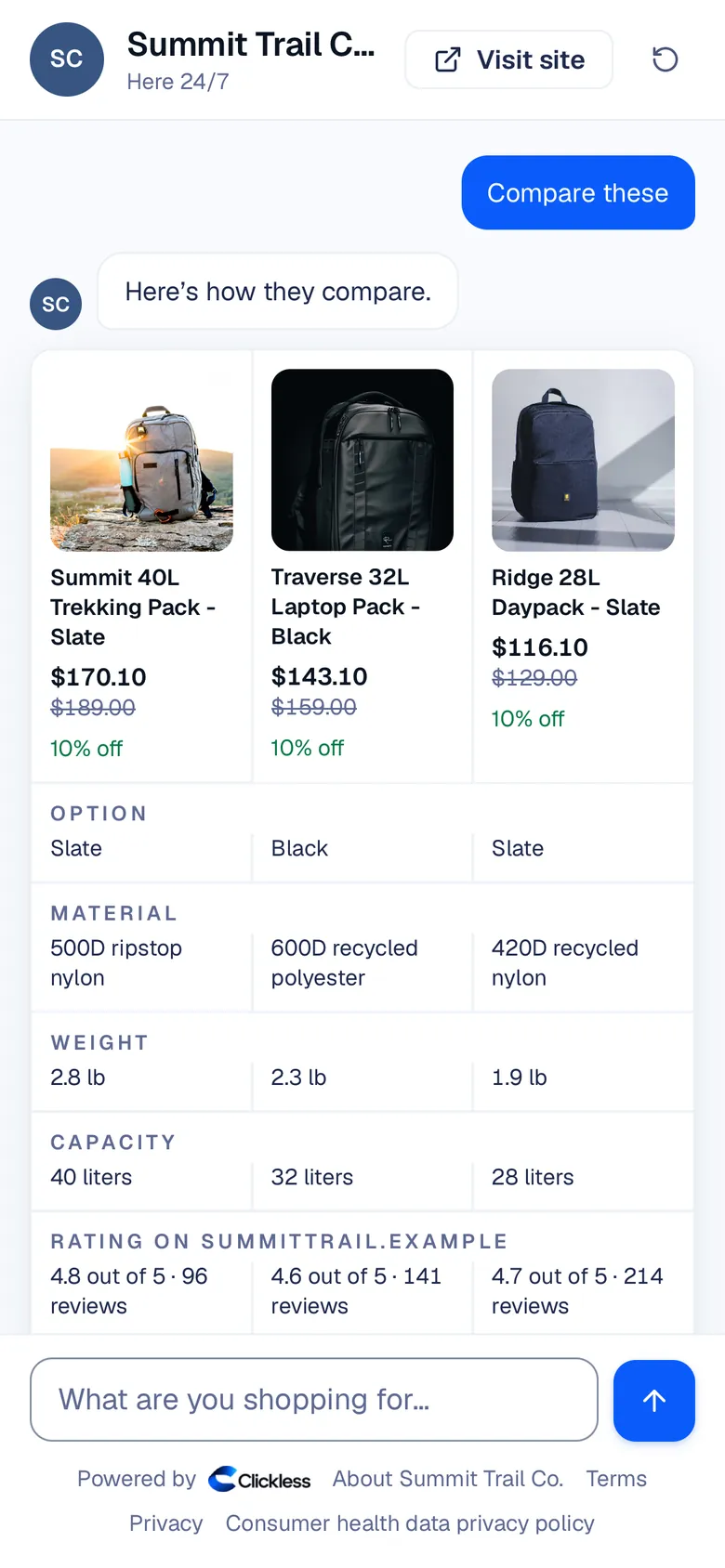
| “What’s the difference between the 32L and the 40L?” | Shows the two side by side in a compare card: the price with the deal, and the catalog facts where they differ, like capacity, weight and material |
| “I want something cheaper.” | Shows lower-priced packs that still fit the trip |
| “What’s covered by the warranty?” | Answers from your approved answer about the warranty |
| “Will it arrive before the 20th?” | Answers from your approved answer about shipping times |
“Which pack for a 3-day hike with a laptop?”
- What the Product Expert does
- Matches capacity and features to the trip, and shows the packs that fit
“Will this fit me? I’m 5 foot 4.”
- What the Product Expert does
- Answers from your sizing and torso-fit guidance, and points to the adjustable models
“Is it waterproof or just water-resistant?”
- What the Product Expert does
- Answers from your product copy, and mentions your rain cover if your copy says the pack needs one
“Does it fit as a carry-on?”
- What the Product Expert does
- Answers from your dimensions, if your copy states them
“What’s the difference between the 32L and the 40L?”
- What the Product Expert does
- Shows the two side by side in a compare card: the price with the deal, and the catalog facts where they differ, like capacity, weight and material
“I want something cheaper.”
- What the Product Expert does
- Shows lower-priced packs that still fit the trip
“What’s covered by the warranty?”
- What the Product Expert does
- Answers from your approved answer about the warranty
“Will it arrive before the 20th?”
- What the Product Expert does
- Answers from your approved answer about shipping times
When a shopper is torn between two or three packs, the compare card puts them side by side in the chat: a photo of each, the price with the deal, the catalog facts where they differ, and “Choose this”.
2
Example: one fictional brand, three ways in
Summit Trail Co. is a fictional outdoor brand that Clickless uses in its screenshots. It sells packs, a rain cover, hip-belt pockets and an extended warranty, and every pick in its chat comes with 10% off.
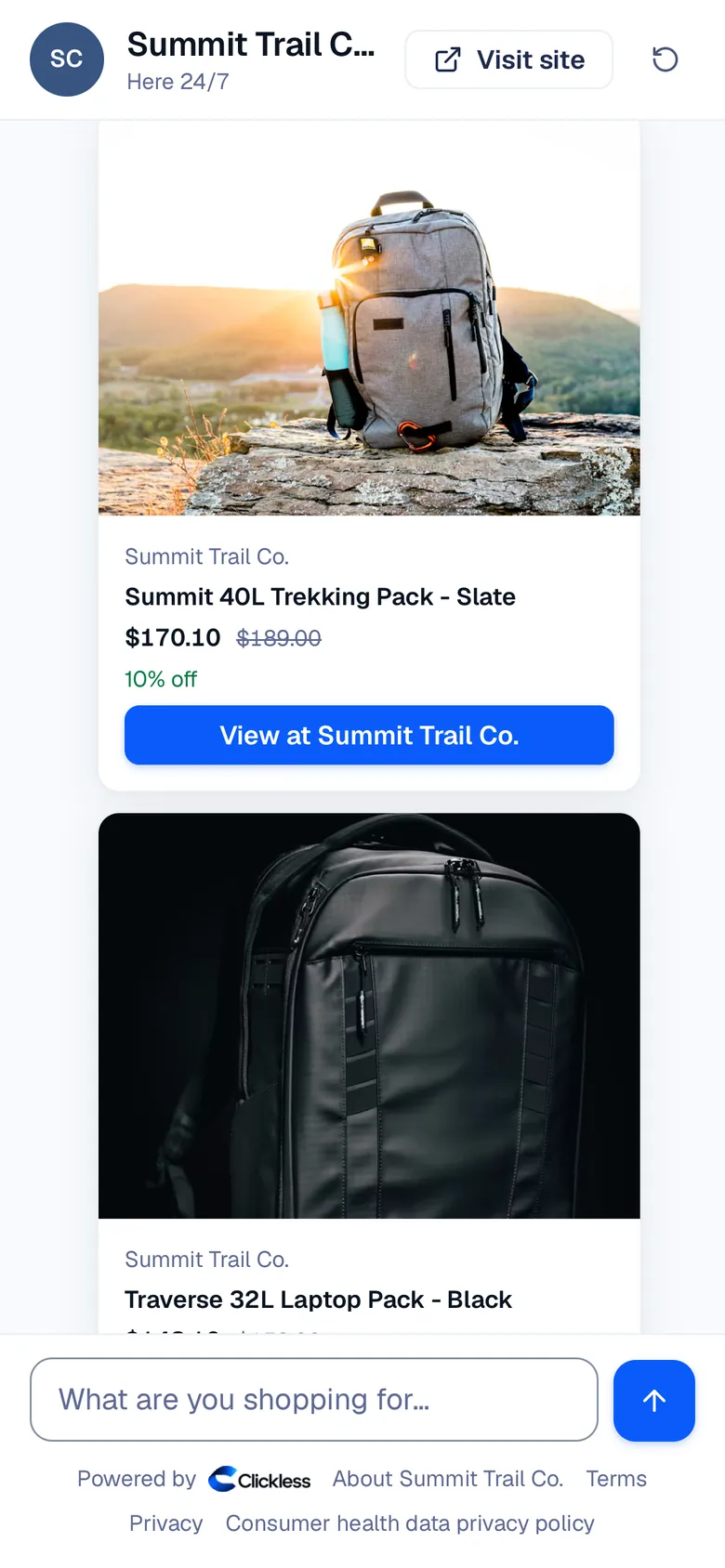
Chat first. A shopper taps a “Find your pack in one chat” ad and types, “Which pack for a 3-day hike with a laptop?” The Product Expert shows the Summit 40L Trekking Pack at $170.10 (was $189) and the Traverse 32L Laptop Pack at $143.10, each with the 10% already in the price. One tap on “View at Summit Trail Co.” opens the pack on the brand’s own store, with the deal carried through to checkout.
Buttons first. A day-hike ad opens on four buttons: Day hikes · 2–3 day trips · Laptop + trail · Pack add-ons. Tapping “Day hikes” brings up the brand’s daypacks.
Quiz first. A trip-planning ad opens on three questions: How long are your trips? Will you carry a laptop? What budget feels right? Each has “Skip, I’ll just ask”. The result shows the packs that fit, and says “Your 10% off is already in the price.”
Each ad gets its own line in the Ads report: opens, chats, site visits, sales and revenue, plus spend and cost per sale once the brand connects its Meta ad account.
3
How should accessories and add-ons work?
Accessories round out an order, but offered too early they look pushy. The moment to offer them is after the shopper has chosen a pack.
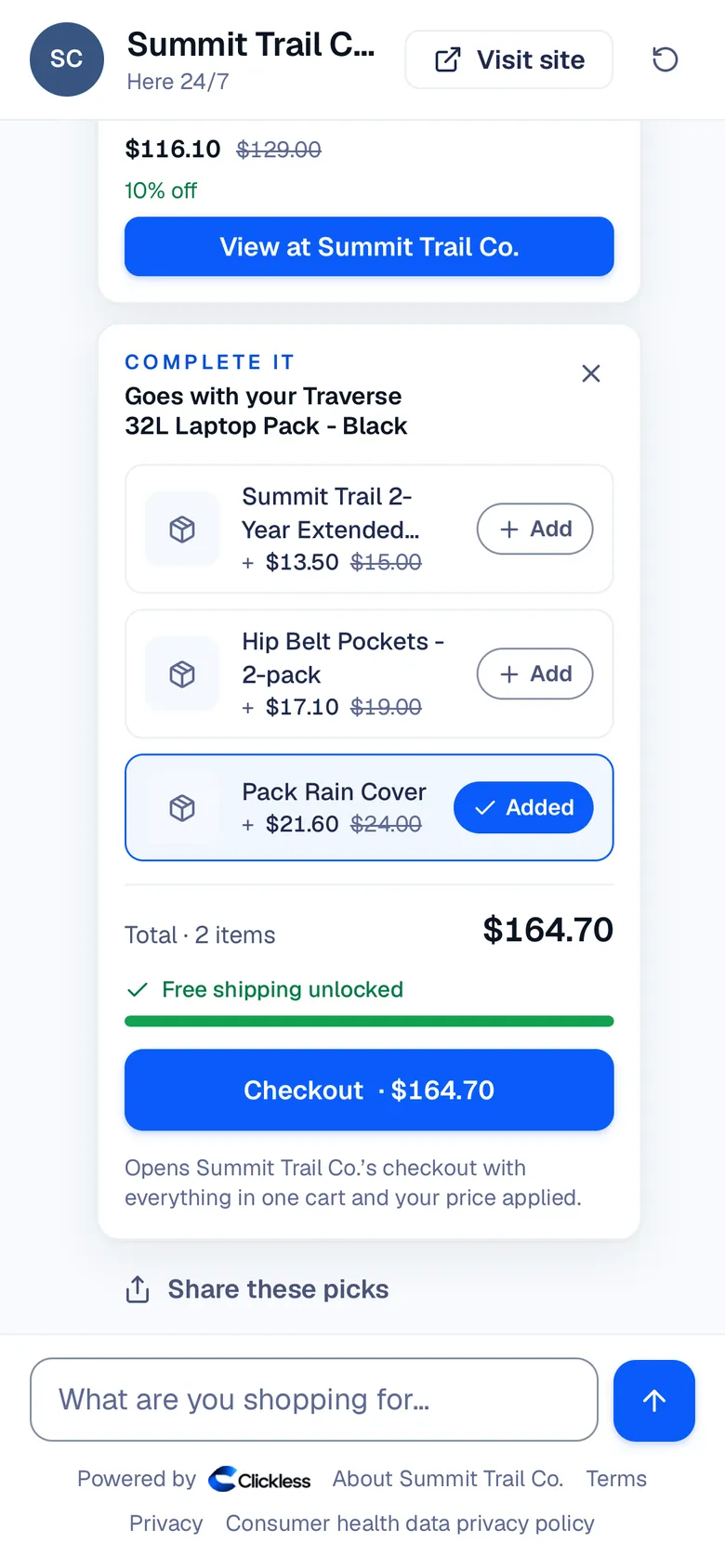
- Mark accessories as add-ons. On a Shopify store, once a shopper picks a pack, “Complete it” offers up to three of your add-ons (a rain cover, hip-belt pockets, a warranty) as toggles, with a running total, a free-shipping nudge and one checkout for everything.
- Answer the “do I need it?” question. If a pack is water-resistant rather than waterproof, say so in its copy and name the rain cover that fits. The Product Expert answers from your copy.
- Keep warranties factual. Write an approved answer that says exactly what’s covered, and the Product Expert answers from it.
4
What should an outdoor brand set up first?
Specs in your product copy. Capacity, weight, dimensions, torso range, laptop sleeve size, materials and water resistance, in plain sentences.
How to choose. Which packs suit day hikes, overnights and travel, and how to choose between two close models, on your site or in your approved answers.
Approved answers. Warranty, returns, shipping times and holiday cut-off dates. The Product Expert answers from them.
Add-ons marked. On a Shopify store, mark your accessories as add-ons so they show under a chosen pack.
One ad, one opening. Start with your top-selling ad. Give it a first line, a deal and the products to lead with, then test two openings 50/50, such as a chat against a quiz.
5
Does it work for gifts?
Gift shoppers ask the questions a product page can’t: “I’m buying for someone who hikes on weekends, around $150?” A Product Expert answers with up to three options that fit. That’s useful through the holidays, when gift traffic peaks and your team has the least time to answer messages.
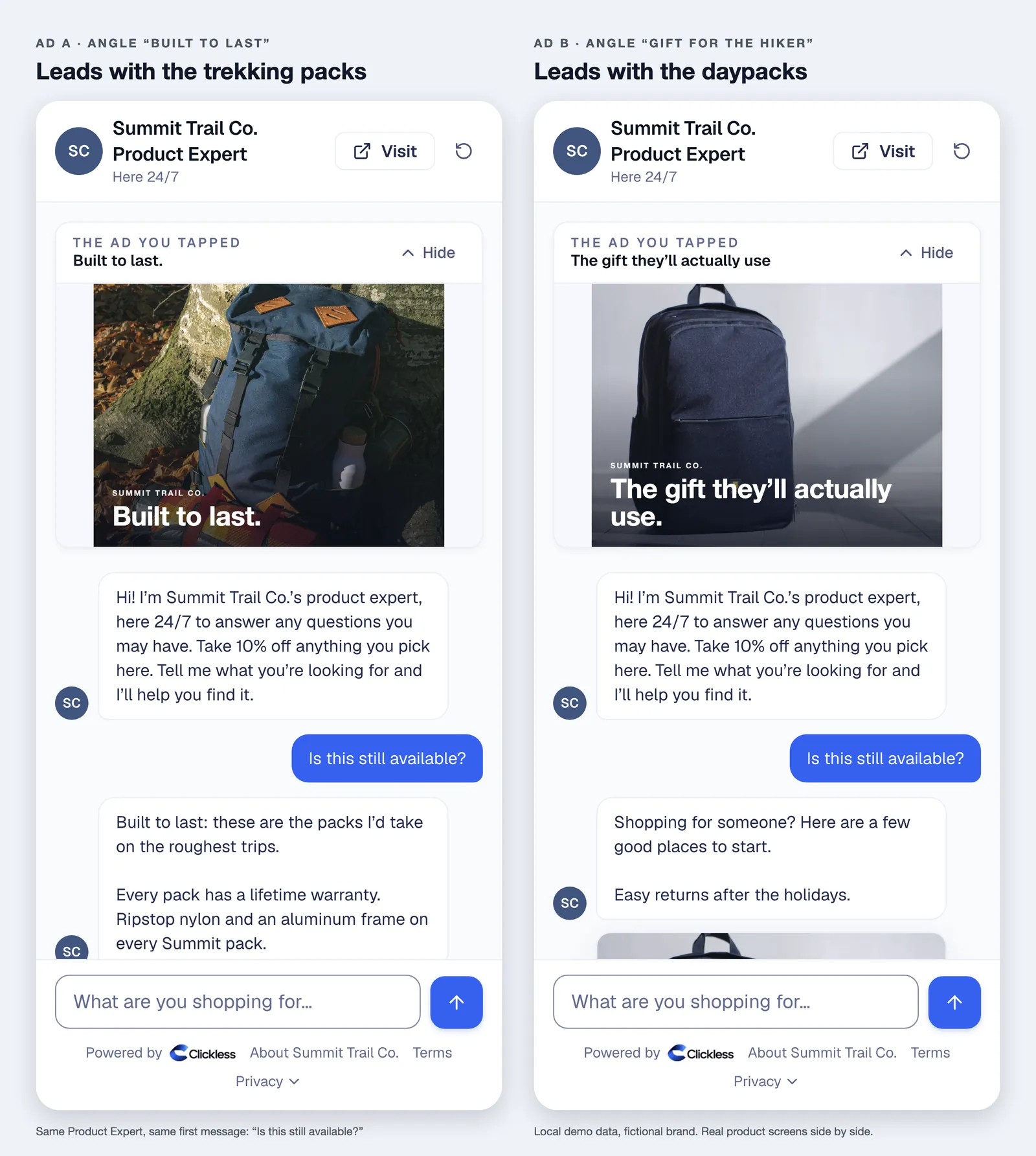
A gift ad can have its own setup: what the ad is about, the products to lead with, its first line and its deal, with the ad’s own picture at the top of the chat. The chat then continues the ad’s promise, which advertisers call message match.
6
Where does it answer?
Its web chat, at its own link, works today from any Meta, TikTok or Google ad that links to a web page, and from emails, a link in a bio and QR codes on hang tags or boxes. It answers Instagram DMs too, from the brand’s own account. Comment replies are coming once Meta approves comment access.
7
What does it cost?
You pay only out of what it saves you: your cost per purchase is read from your own ad account, not typed in, and checked against your store’s orders, and when your Product Expert beats it, Clickless keeps 30% of what it saves on each sale for founding brands (50% after the founding round). Doesn’t beat your number? You pay $0. No setup fee, no monthly fee.
Free 7-day test: no Clickless fee on sales in your Product Expert’s first 7 days live. You still pay for your own ads.
One order, one fee: never stacked. Every rate is on the pricing page.
Questions brands ask
What questions can an outdoor gear Product Expert answer?
The ones a shop clerk gets: which size for a trip, whether a laptop fits, how to fit the torso, what’s waterproof, what fits as a carry-on, and how two models differ. It answers from the brand’s own site, catalog and approved answers.
Can it recommend accessories like rain covers?
Yes. On a Shopify store, mark accessories as add-ons: once a shopper picks a pack, the chat shows up to three of them as toggles, with a running total and one checkout for everything.
Can each ad open on a different question?
Yes. A trip ad can open on a quiz about trip length, a laptop-pack ad on buttons, and a gift ad on a chat, each with its own first line and deal.
Where do shoppers check out?
On your own store, with the product and the deal ready. Clickless never takes payment or holds goods, and you ship as usual.
How do I know which ad sold?
Every conversation carries a token from the ad that opened it. The token rides to your checkout and your store reports the order back, so each order shows its ad and creative, and each ad gets its own line in the Ads report. A sale from an ad counts for 7 days after the click by default, or 28 or 60 days if you choose.

Try it on your top-selling ad.
Free 7-day test: no Clickless fee on sales in your Product Expert’s first 7 days live. You still pay for your own ads.