

Results · October 2026
Clickless results: one brand’s two-week test
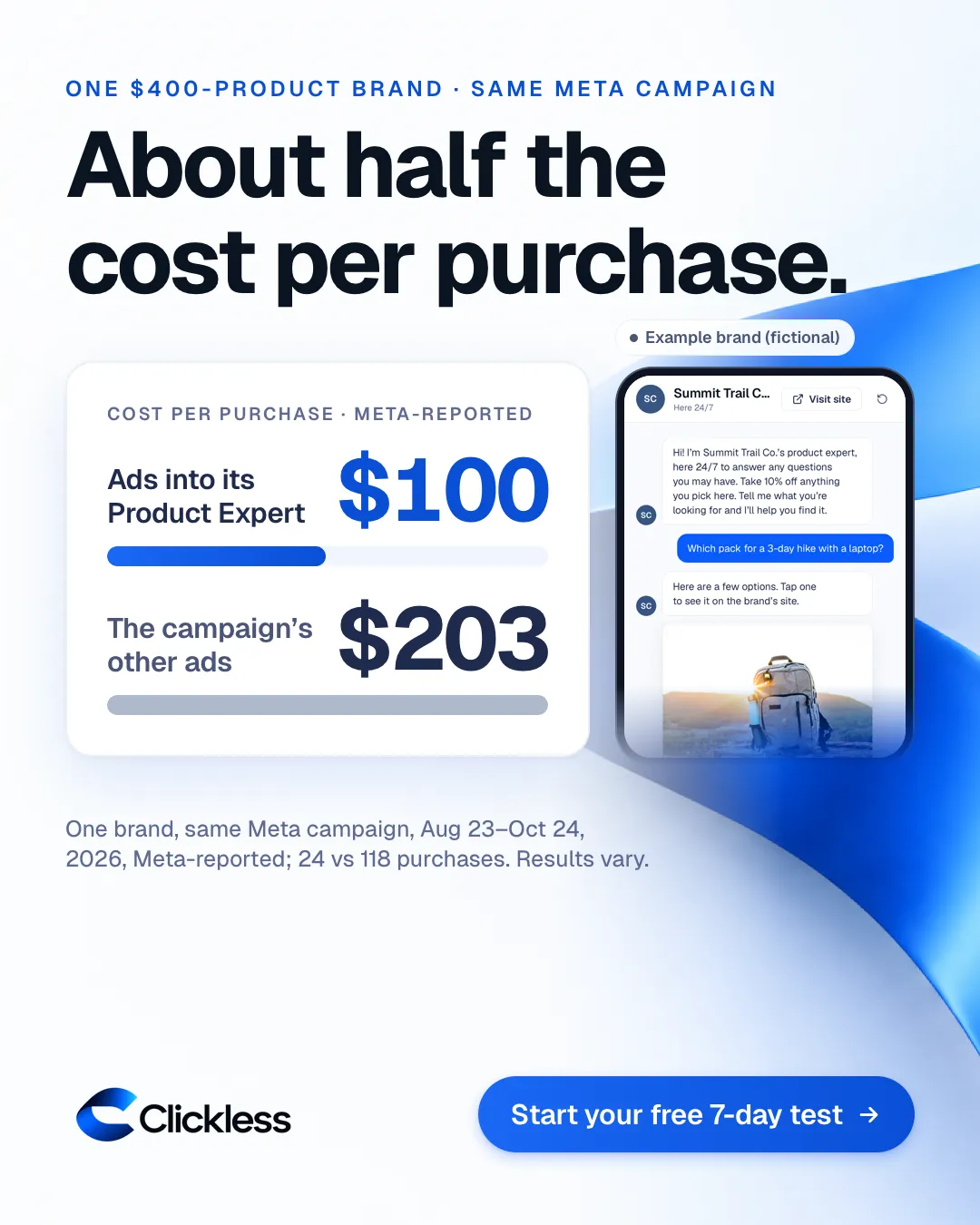
In a two-week test inside the same Meta campaign, the ads that opened one brand’s Product Expert cost about half as much per purchase as the campaign’s other ads: $100 vs $203, with 4.9x vs 1.9x return on ad spend, on 24 vs 118 purchases. From October 10 to 23, 2026, the same ads had 3.8x the add-to-carts per ad dollar. Every number is Meta-reported, on Meta’s default attribution, from one brand affiliated with Clickless. It wasn’t a randomized test, and results vary.
1
The summary
A two-week test inside the same Meta campaign, Meta-reported (Meta’s default attribution): $100 vs $203 per purchase, 4.9x vs 1.9x return on ad spend, 3.8x the add-to-carts per ad dollar; 24 vs 118 purchases.
2
Who is the brand?
A brand with a $400 product. It’s affiliated with Clickless, so read these numbers as Clickless’s own test, not an independent customer’s result. We keep brand names private.
3
What was compared?
Inside one Meta campaign, the brand pointed 4 ad sets at its Product Expert for about two weeks. The campaign’s other 31 ad sets kept sending people to the brand’s own website.
August 23 to October 24, 2026 is the campaign’s report window, not the length of the test. The Product Expert’s ad sets ran for about two weeks of it, in October.
4
Cost per purchase
| Meta-reported | Ads that opened the Product Expert | The campaign’s other ads |
|---|---|---|
| Ad sets | 4 | 31 |
| Spend | $2,410 | $23,916 |
| Purchases | 24 | 118 |
| Cost per purchase | $100.42 | $202.68 |
| Return on ad spend | 4.9x | 1.9x |
Ad sets
- Ads that opened the Product Expert
- 4
- The campaign’s other ads
- 31
Spend
- Ads that opened the Product Expert
- $2,410
- The campaign’s other ads
- $23,916
Purchases
- Ads that opened the Product Expert
- 24
- The campaign’s other ads
- 118
Cost per purchase
- Ads that opened the Product Expert
- $100.42
- The campaign’s other ads
- $202.68
Return on ad spend
- Ads that opened the Product Expert
- 4.9x
- The campaign’s other ads
- 1.9x
The ad sets that opened the Product Expert ran at 50.5% lower cost per purchase than the campaign’s other ad sets: about half.
5
Add-to-carts per ad dollar
| Meta-reported, Oct 10–23, 2026 | Ads that opened the Product Expert | The campaign’s other ads |
|---|---|---|
| Add-to-carts | 109 | 15 |
| Cost per add-to-cart | about $20 | about $77 |
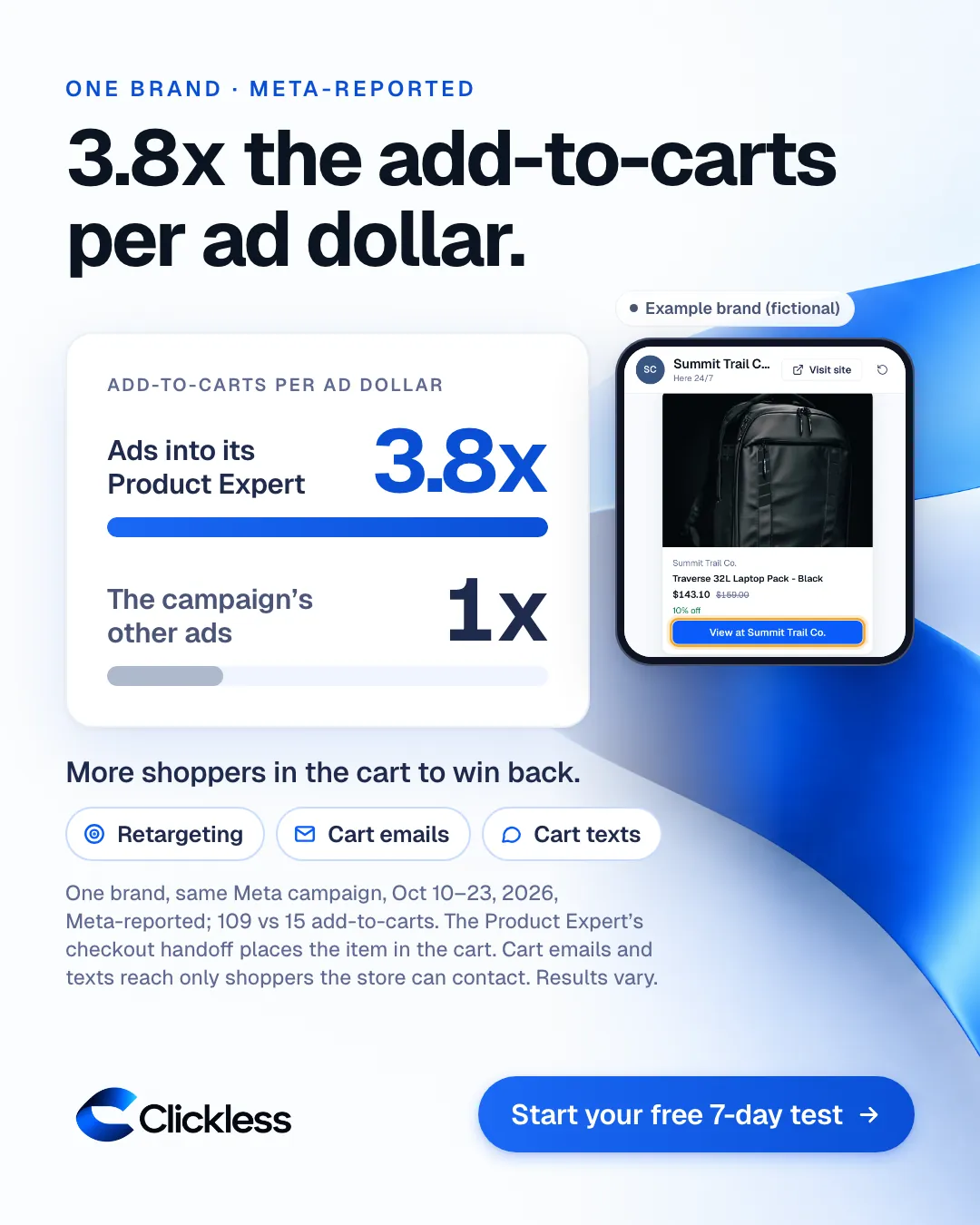
| Add-to-carts per ad dollar | 3.8x | 1x |
Add-to-carts
- Ads that opened the Product Expert
- 109
- The campaign’s other ads
- 15
Cost per add-to-cart
- Ads that opened the Product Expert
- about $20
- The campaign’s other ads
- about $77
Add-to-carts per ad dollar
- Ads that opened the Product Expert
- 3.8x
- The campaign’s other ads
- 1x
Read this one carefully. When a shopper is ready, the Product Expert hands them to checkout with the product already in the cart, so its add-to-carts aren’t the same act as a shopper tapping “Add to cart” on a product page. Judge the Product Expert on purchases.
The useful reading is the size of the pool: more shoppers in the cart for your retargeting, cart emails and texts to win back. Cart emails and texts reach only the shoppers your store can contact.
6
How were these counted?
- Meta’s numbers, not Clickless’s. Every figure on this page comes from the brand’s own Meta Ads Manager exports, on Meta’s default attribution: purchases within 7 days of a click or 1 day of a view. They aren’t click-only.
- Not what Clickless bills on. Clickless counts a sale from an ad within 7 days of the click by default (28 or 60 days if a brand chooses) and never counts a view without a click. The Ads report shows Meta’s count beside the orders confirmed in the brand’s store.
- Small numbers. 24 purchases on one side is a small sample. With more data, the size of the gap could move a lot in either direction.
7
What this doesn’t show
- It isn’t randomized. The Product Expert’s ad sets weren’t a random half of the audience. They can differ from the rest in creative, audience and timing: they ran for about two weeks in October, while the rest of the campaign ran across its whole report window.
- It’s one brand. One product, one price point.
- It’s an affiliated brand. The brand had every reason to set the test up well.
The next step is a 50/50 test on matched creative, using Meta’s A/B test so each person sees only one destination. We’ll add it here when one has run a full 7 days.
8
How to run the same test
Pick one ad set that already sells. Duplicate it, change only the website URL to your Product Expert’s link, let Meta’s A/B test split the audience, and run it for 7 days without touching the budget. Then compare cost per purchase on both sides. The full steps are in How to split test the destination of a Meta ad.
Free 7-day test: no Clickless fee on sales in your Product Expert’s first 7 days live. You still pay for your own ads.
Questions people ask
What results has Clickless published?
A two-week test inside the same Meta campaign, Meta-reported (Meta’s default attribution): $100 vs $203 per purchase, 4.9x vs 1.9x return on ad spend, 3.8x the add-to-carts per ad dollar; 24 vs 118 purchases. Not a randomized test, and the brand is affiliated with Clickless. Results vary.
Is this a randomized test?
No. The Product Expert’s ad sets and the rest of the campaign can differ in creative, audience and timing. A 50/50 test on matched creative is the next step, and we’ll add it here when one has run a full 7 days.
Whose numbers are these?
Meta’s, from the brand’s own Ads Manager exports, on Meta’s default attribution (7-day click plus 1-day view). They aren’t orders confirmed in the brand’s store, and they aren’t what Clickless bills on: Clickless counts a sale within 7 days of an ad click by default and never counts a view.
Why read the add-to-carts carefully?
The Product Expert’s checkout handoff places the item in the cart, so its add-to-carts aren’t the same act as on a product page. Judge it on purchases. The add-to-cart figure shows a bigger pool of shoppers to retarget and win back.
Will my brand see the same results?
Results vary by brand, product and creative. The quickest way to know is a 7-day test on one ad set, split 50/50 between your landing page and your Product Expert.

Run your own test.
No Clickless fee on sales in your Product Expert’s first 7 days live. You still pay for your own ads. Results vary.