

Guide · November 2026
What do abandoned-cart email benchmarks say in 2026?
About 70.22% of online shopping carts are left before checkout, the average of 50 studies on the Baymard Institute's list, last updated September 22, 2025. Abandoned-cart emails among Klaviyo's customers averaged $6.77 in revenue per recipient in a report published October 2, 2026. No independent study publishes a single share of carts brought back. What each number measured is the part worth keeping.
AI Product Experts that sell. You pay only when they do.
1
How many carts are abandoned?
Baymard Institute keeps a public list of cart-abandonment statistics and averages them. On the update of September 22, 2025, that average is 70.22%, drawn from 50 studies. The individual rates on the list run from 55% to 84%, across many years and many definitions of a cart. 70.22% is a long-run reading of published research. It is not your store's rate this month, and it is not a target to hit.
The page is Baymard's cart abandonment statistics. This guide was checked against it on October 30, 2026. Baymard sells checkout research, not a cart-email product, and the page shows the 50 studies behind the average. Treat it as independent of the email and text tools below.
2
Why do shoppers leave a cart?
On that same page, Baymard says its latest study of reasons found that 42% of US online shoppers have abandoned a cart because they were "just browsing / not ready to buy." That is saving, comparing, and looking. A reminder does not turn all of it into an order.
Baymard then lists reasons among everyone else. The page does not print that survey's sample size, or a date of its own apart from the September 22, 2025 update on the statistics list. The shares add to more than 100%, so they overlap: a shopper can name more than one reason.
| Reason Baymard lists, after setting "just browsing" aside | Share |
|---|---|
| Extra costs too high (shipping, tax, fees) | 40% |
| Delivery was too slow | 20% |
| Did not trust the site with credit card information | 19% |
| The site wanted an account | 18% |
| Checkout was too long or complicated | 17% |
| The site had errors or crashed | 17% |
Extra costs too high (shipping, tax, fees)
- Share
- 40%
Delivery was too slow
- Share
- 20%
Did not trust the site with credit card information
- Share
- 19%
The site wanted an account
- Share
- 18%
Checkout was too long or complicated
- Share
- 17%
The site had errors or crashed
- Share
- 17%
Source: the same Baymard page, read October 30, 2026.
3
What do abandoned-cart emails and texts return?
Two vendors publish flow benchmarks for their own customers. Both sell the software they measure. Read them as a picture of those customer bases, not as incremental lift and not as a forecast for a store outside them.
Klaviyo. On October 2, 2026, Klaviyo published "The abandoned cart benchmarks report: 2026 data", from more than 110,000 Klaviyo customers. Revenue per recipient is revenue the flow is credited with, divided by recipients who got the message.
| Klaviyo abandoned-cart flows, October 2, 2026 | Text | |
|---|---|---|
| Average revenue per recipient | $6.77 | $4.48 |
| Top 10% of brands, revenue per recipient | $13.70 | $8.69 |
| Average click rate | 6% | 10.3% |
Average revenue per recipient
- $6.77
- Text
- $4.48
Top 10% of brands, revenue per recipient
- $13.70
- Text
- $8.69
Average click rate
- 6%
- Text
- 10.3%
Postscript. On its 2026 SMS benchmarks page, abandoned-cart text conversion runs from 3.97% at the 25th percentile to 7.84% at the 75th. The data window printed there is January 1 through December 15, 2025. A Postscript article on the same benchmarks says the set is more than 17,000 Shopify stores. On the benchmarks page, the same abandoned-cart row shows a click rate from 9.53% to 17.28% at those two percentiles.
That conversion range is the share of those text messages that converted in Postscript's reporting. It is not the share of abandoned carts brought back. No independent figure for that share is published, and this page does not invent one.
4
When does a cart reminder raise purchases?
Li, Luo, Lu, and Moriguchi ran randomized field experiments, published in the Journal of Marketing in 2021 (doi.org/10.1177/0022242920959043). In two experiments on more than 40,500 customers, people were assigned to a cart reminder or to none, in blocks of time after they left the cart. A reminder by email or in an app 30 to 60 minutes after abandonment made a purchase less likely than no reminder. A reminder one to three days later made a purchase more likely than no reminder. A further experiment on 23,900 customers found the same pattern when the reminder was a text.
The authors also point out a trap in the raw numbers. Early reminders can show the most purchases in absolute terms and still lose to silence once you compare them with people who got nothing. A holdout is what makes the timing readable.
This is one research program. It is not a delay to paste into every flow without looking at the brand.
5
What did a randomized retargeting test find?
Johnson, Lewis, and Nubbemeyer, in the Journal of Marketing Research in 2017 (doi.org/10.1509/jmr.15.0297), measured one online retailer's display retargeting campaign in a randomized experiment. The published abstract says the ads lifted website visits 17.2% and purchases 10.5% against the control. One campaign is not a rate every retargeting program should expect. It is evidence, from a randomized control, that a retargeting ad can add purchases beyond the people who would have bought anyway.
6
What changes when more shoppers reach the cart?
Cart emails and texts reach only the shoppers your store can contact. A larger set of add-to-carts is a larger pool for those messages, and for retargeting. It is not, by itself, more sales, and it is not a promise of more cart emails.
Clickless: AI Product Experts that sell. You pay only when they do. The commerce layer for AI agents.
A brand's Product Expert is the chat behind its ads and links. It knows what the brand sells, recommends what fits, applies the deal, and sends the shopper to the brand's own checkout. The brand stays the merchant. In one test, ads that opened the Product Expert produced more add-to-carts per ad dollar than the other ads in the same Meta campaign. The approved summary, and the two source lines that go with it:
A two-week test inside the same Meta campaign, Meta-reported (Meta’s default attribution): $100 vs $203 per purchase, 4.9x vs 1.9x return on ad spend, 3.8x the add-to-carts per ad dollar; 24 vs 118 purchases.
One brand affiliated with Clickless, with a $400 product: a two-week test inside the same Meta campaign (report window Aug 23–Oct 24, 2026). Meta-reported, Meta’s default attribution; 24 vs 118 purchases. Not a randomized test. Results vary.
One brand affiliated with Clickless, same Meta campaign, Oct 10–23, 2026. Meta-reported, Meta’s default attribution; 109 vs 15 add-to-carts. The Product Expert’s checkout handoff places the item in the cart. Results vary.
Read the add-to-cart line as 3.8x the add-to-carts per ad dollar, 109 versus 15, from October 10 to 23, 2026. When a shopper is ready, the handoff places the item in the cart, so those add-to-carts are not the same act as a tap on a product page. Judge the Product Expert on purchases. The tables, and what the test does not show, are on the results page.
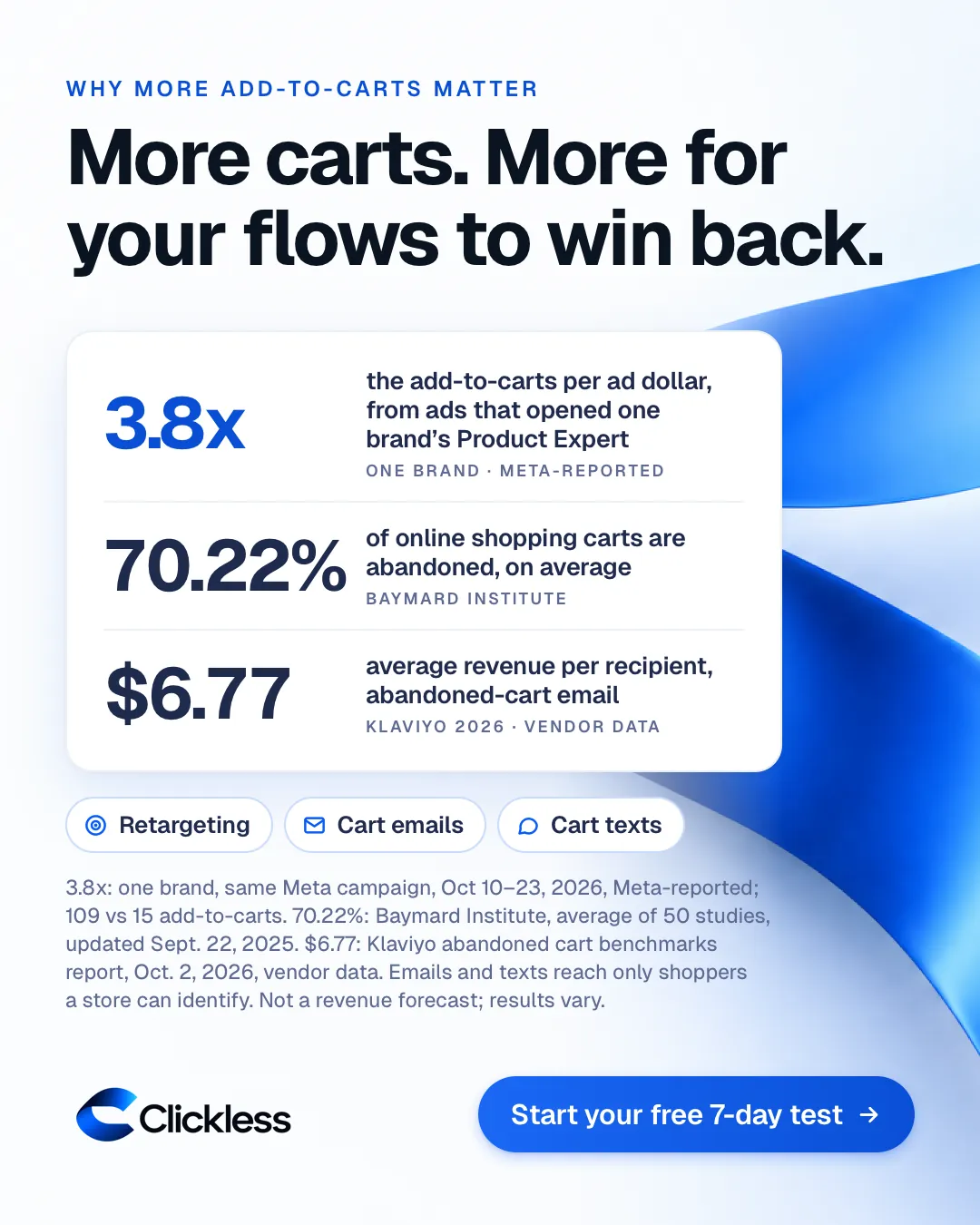
The phone in that ad is Summit Trail Co., an example brand (fictional). The cart rate and the email figure on the creative are the Baymard and Klaviyo numbers above, not a forecast for your flows.
7
What are these numbers not?
Not your store's cart rate. 70.22% averages 50 studies that do not share one method.
Not a rate of carts brought back. No independent figure for that is published.
Not incremental lift, for the Klaviyo and Postscript figures. They describe those companies' customers.
Not a randomized read of a Product Expert. The add-to-cart comparison is one affiliated brand's two-week test, Meta-reported on Meta's default attribution. The journal papers above are the randomized studies, and they measured reminders and display ads, not a Product Expert.
8
How should a brand use the benchmarks?
Start from your own cart rate. Use 70.22% as the long-run published average, then compare the store with itself.
Separate "just browsing" from reasons you can change, such as a surprise shipping cost or a forced account. Baymard's reason list is a map, and it does not print a sample size.
Read vendor revenue per recipient as that vendor's customers, on that vendor's credit for the sale. Klaviyo's $6.77 and Postscript's 3.97% to 7.84% are not your forecast.
If you test reminder timing, keep a holdout. In the Journal of Marketing experiments, a reminder 30 to 60 minutes after abandonment did worse than silence, and a reminder one to three days later did better.
Grow the pool those flows can reach. An ad can open a chat instead of a landing page, so the shopper can ask a question and reach the brand's checkout with the item in the cart. Add-to-cart and cost per purchase are defined in the glossary, and how Clickless works is the short version.
A follow-up from the same Product Expert, after someone leaves checkout, is coming soon. Until then, the cart emails and texts in the studies above stay the store's.
Media buyers who want to compare a chat with the current page, on one ad set, can start from the media buyers page.
Set up your Product Expert at getclickless.ai/brands. Free 7-day test: no Clickless fee on sales in your Product Expert's first 7 days live. You still pay for your own ads.
Sources
Questions brands ask
What is the average online cart abandonment rate?
Baymard Institute averages 50 studies at 70.22%. The list was last updated September 22, 2025. The studies use different years and different definitions of a cart, so the figure is a long-run published average, not your store's rate this month.
How much revenue do abandoned-cart emails make per recipient?
Klaviyo's report of October 2, 2026, on more than 110,000 of its customers, puts average abandoned-cart email revenue per recipient at $6.77, and $13.70 for the top 10% of those brands. Text messages in the same report averaged $4.48. Klaviyo sells the software it measured. The figure is revenue the flow is credited with, divided by recipients. It is not a holdout test, and it is not a forecast for your store.
What conversion rate do abandoned-cart texts show?
Postscript's 2026 benchmarks, data from January 1 to December 15, 2025, put abandoned-cart text conversion at 3.97% for a store at the 25th percentile and 7.84% at the 75th. A Postscript article on the same set says it covers more than 17,000 Shopify stores. That is the share of those messages that converted in Postscript's reporting, not the share of abandoned carts brought back. Postscript sells the software.
When should a cart reminder go out?
In Li, Luo, Lu, and Moriguchi's randomized field experiments, published in the Journal of Marketing in 2021, a reminder 30 to 60 minutes after abandonment lowered purchases versus no reminder, and a reminder one to three days later raised them. One program studied more than 40,500 customers by email and app, and a later one studied 23,900 by text. That is one set of studies, not a timer every brand should copy without a test of its own.
Do more add-to-carts mean more revenue from cart flows?
They mean a bigger pool of shoppers your store can email or text. Cart emails and texts reach only the shoppers your store can contact, and a vendor's revenue per recipient is not a forecast. In one brand's test the figure to read is 3.8x the add-to-carts per ad dollar. One brand affiliated with Clickless, same Meta campaign, Oct 10–23, 2026. Meta-reported, Meta’s default attribution; 109 vs 15 add-to-carts. The Product Expert’s checkout handoff places the item in the cart. Results vary.
Does Clickless send the abandoned-cart email?
No. The emails and texts in these benchmarks are the store's. A follow-up from the same Product Expert after someone leaves checkout is coming soon. Today a Product Expert answers from an ad or a link, recommends what fits, and hands the shopper to the brand's own checkout. You pay only when it sells.
Related guides
AI Product Expert for outdoor gear brands
How an outdoor gear brand’s Product Expert answers trip-length, fit and capacity questions, picks the right pack per ad, and hands off to your checkout.
AI Product Expert for skincare brands
How a skincare brand’s Product Expert answers skin-type, routine and ingredient questions from your own product copy, per ad, and checks every reply before it’s sent.
AI product quiz for Shopify: how to run one per ad
Run a product quiz per ad on Shopify: each ad opens your Product Expert on its own quiz, shows 1 to 3 products with your deal, then answers follow-ups.
Read the guide: AI product quiz for Shopify: how to run one per ad

Put a Product Expert on your next ad.
AI Product Experts that sell. You pay only when they do. No setup fee, no monthly fee.