

Guide · November 2026
How to make your store readable to ChatGPT, Claude, Gemini and Grok
A store is readable when a crawler can fetch the product name, the price and a plain description as text on the page, and the site's robots.txt file allows that fetch. Readable pages do not decide whether ChatGPT, Claude, Gemini or Grok names the brand. Those tools still choose what to say.
AI Product Experts that sell. You pay only when they do.
1
What does a readable store change?
A readable store removes reasons a page cannot be fetched or parsed. It does not pick the brand an answer names.
Google's guide to AI Overviews and AI Mode, last updated December 10, 2025, says a page is eligible to be shown as a supporting link when it is indexed and eligible for a snippet in Google Search. Google says there are no additional technical requirements for those features, and no new machine-readable file or special schema.org type is required. Meeting the requirements does not mean Google will crawl, index or show the page. The same page still asks for crawling to be allowed in robots.txt, for important content to be text, and for structured data to match the text a person sees.
2
Which crawler rules are separate decisions?
Search crawlers and training crawlers are different settings. Blocking one does not do the job of the other. The names in the table are the user-agent tokens each company publishes.
| Token | What the company says it is for | What the company says a block does |
|---|---|---|
| OAI-SearchBot | OpenAI search | The site is left out of ChatGPT search answers, and can still appear as a navigational link |
| GPTBot | Training OpenAI's foundation models | The site is saying that content should not be used for that training |
| ChatGPT-User | A page visit a person started | Not the control for search inclusion. OpenAI says robots.txt may not apply to these visits |
| Claude-User | Fetching a page when someone asks Claude | Can reduce visibility for user-directed web search |
| Claude-SearchBot | Claude search quality | Can reduce visibility and accuracy in user search results |
| ClaudeBot | Training Anthropic's models | Future material should stay out of training datasets |
OAI-SearchBot
- What the company says it is for
- OpenAI search
- What the company says a block does
- The site is left out of ChatGPT search answers, and can still appear as a navigational link
GPTBot
- What the company says it is for
- Training OpenAI's foundation models
- What the company says a block does
- The site is saying that content should not be used for that training
ChatGPT-User
- What the company says it is for
- A page visit a person started
- What the company says a block does
- Not the control for search inclusion. OpenAI says robots.txt may not apply to these visits
Claude-User
- What the company says it is for
- Fetching a page when someone asks Claude
- What the company says a block does
- Can reduce visibility for user-directed web search
Claude-SearchBot
- What the company says it is for
- Claude search quality
- What the company says a block does
- Can reduce visibility and accuracy in user search results
ClaudeBot
- What the company says it is for
- Training Anthropic's models
- What the company says a block does
- Future material should stay out of training datasets
OpenAI's crawler overview, read November 13, 2026, says the search setting and the training setting are independent. A site can allow OAI-SearchBot and disallow GPTBot. A robots.txt change can take about 24 hours to show up in search. OpenAI says to allow OAI-SearchBot, and requests from the IP ranges it publishes, if the site should be eligible for those search results.
Anthropic's help center, read November 13, 2026, says its crawlers honor robots.txt, and that a block has to be repeated on every subdomain you mean to exclude. As of October 30, 2026, Anthropic says it has started to honor a machine-readable preference for "no AI training." A robots.txt rule that names ClaudeBot is more specific, and Anthropic follows that named rule even when the general training preference says something else.
For Google Search, including AI Overviews and AI Mode, the crawl control Google names is robots.txt for its search crawler. Google points to a separate control, Google-Extended, for limiting training and grounding in some of its other systems. This guide does not describe a Grok crawler rule, because no Grok crawler page was used as a source. The AI search check still asks Grok, along with ChatGPT, Claude and Gemini.
3
What has to be on the product page?
Google's product-snippet documentation, last updated September 8, 2026, says product rich results are for a page about one product, or about variants of that same product when each variant has its own URL. A category page is not a product page. The product name is required. A snippet also needs a review, an aggregate rating, or a price.
Google says to put Product structured data in the HTML the server sends. Markup that JavaScript fills in later can make shopping crawls less frequent and less reliable for price and availability. Match that markup to the text a shopper sees, on a page that is not blocked in robots.txt, not marked noindex, and not behind a login. Google does not promise a rich result, and a recrawl can take several days.
A sitemap tells Google which full URLs you prefer. Google's sitemap guide, last updated July 8, 2026, says submitting one is a hint. Google may not download the file or crawl every URL in it. A sitemap posted at the site root can cover the site. You can name it from robots.txt with a Sitemap line, or submit it in Search Console. Use a full URL, with https and the domain, rather than a short path.
4
Do you need an llms.txt file?
An llms.txt file is a short markdown map. Jeremy Howard's proposal, updated August 10, 2026, says the file sits at /llms.txt, or under a path it covers, and that the required piece is an H1 with the name of the site. A blockquote summary and H2 sections of links can follow. A tool is expected to read the file, then follow the links it needs. Those links should point at markdown versions of the pages.
The proposal treats a sitemap as a different object: a sitemap lists pages for search engines and is often too large to drop into a prompt, while robots.txt says what access is acceptable. The author also writes that Chrome's Lighthouse audits sites for an llms.txt file as part of its agentic browsing checks. That is his account, not a Google Search requirement.
Publish an llms.txt file if you want a curated map for tools that look for one. Do not treat the file as a switch that gets the brand named. Google already says those features do not require a new machine-readable file.
Fictional example, not a live file:
# Summit Trail Co.

> Fictional example. Packs for day hikes and longer trips. Shoppers buy on the brand's own store.

## Start here

- [How to choose a pack](https://summittrail.example/choose.md): Trip length, a laptop, and budget6
How do you see whether a brand is named?
The AI search check is free and takes about a minute. It works out questions shoppers ask about what the brand sells, asks ChatGPT, Claude, Gemini and Grok with web search on, and shows whether they name the brand and who they name instead. It also reports crawler access, structured data, llms.txt and the sitemap. It reports the answers. It does not change them.
Clickless, based in Scottsdale, Arizona, runs that check.
7
Where does a Product Expert fit?
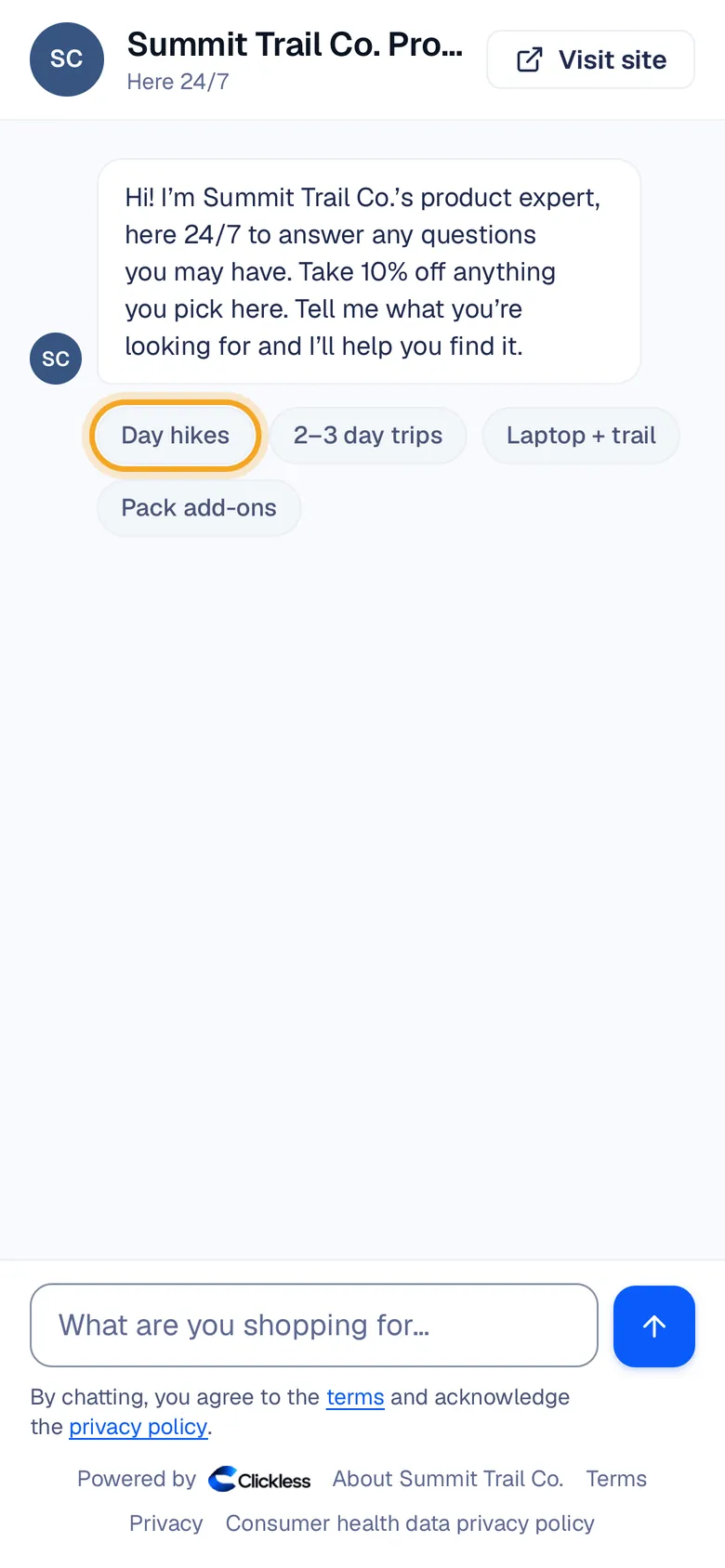
A Product Expert is a brand expert that helps sell a brand's products and offers, 24/7. It is not a stand-in for a readable catalog, and a readable catalog is not a Product Expert.
It opens from an ad, a link, a QR code or an Instagram DM. On every channel it starts with: "Hi! I'm {Brand}'s product expert, here 24/7 to answer any questions you may have." It answers in the brand's voice, from the brand's site, catalog and approved answers, and every reply is checked before it is sent. Asked whether it is a person, it says it is that brand's AI product expert, not a person. It recommends what fits, applies the deal, and sends the shopper to the brand's own checkout. The shopper pays the brand, and the brand ships. Clickless does not take payment or hold the goods.
You pay only when it sells. There is no setup or monthly fee. For seven days after the Product Expert goes live, there is no Clickless fee on its sales. That window is the free 7-day test. The brand still pays for its own ads. Most brands are live within two business days. On Shopify, the brand connects its store and Clickless finishes the connection, usually by the next business day, while Shopify reviews the public app (submitted October 14, 2026). A store on another platform uploads a product file.
Read what a Product Expert is, then set up a brand or see how it works. The glossary defines a Product Expert in one place. A related guide covers what changes for a brand when shoppers ask these tools.
8
What should you do this week?
Open robots.txt. Allow the search crawlers you want on product URLs: OAI-SearchBot, Claude-User, Claude-SearchBot, and Google's search crawler. Decide GPTBot and ClaudeBot as training choices, apart from search.
Open a product page and view the HTML the server sends. The name, the price and a description should be in that HTML. Add Product structured data there, matching the visible text, on a page about one product.
Publish a sitemap of full product URLs at the site root, or submit it in Search Console, and point to it from robots.txt.
If you want a short map for tools that look for llms.txt, publish one: an H1 with the brand name, a one-paragraph summary, and links to the product and policy pages. Do not expect AI Overviews to require it.
Click the main product links. Repair pages that error, loop or sit behind a login.
Run the AI search check and read who gets named. Use that report to decide whether the page work is enough, or whether ads should also open a Product Expert.
Sources
Questions brands ask
Does a readable store get a brand named by ChatGPT?
A readable store can be fetched and parsed. It does not choose the name in the answer. Google's AI-features page, updated December 10, 2025, says there are no extra technical requirements for AI Overviews or AI Mode, and that meeting them does not mean a page will be shown. OpenAI, Anthropic and Google each document their own crawlers. None of those pages say a file on the site picks the brand that gets named.
Should a brand block training crawlers?
Search and training are separate settings. OpenAI's crawler overview, read November 13, 2026, says disallowing GPTBot tells OpenAI not to use the content to train foundation models, and that this setting is independent of OAI-SearchBot. Anthropic's help center, read the same day, says restricting ClaudeBot signals that future material should stay out of training sets, and that a rule naming ClaudeBot is followed even when a general training preference differs. Blocking the search crawlers is the change that can keep a page out of those search answers.
Is an llms.txt file required for Google's AI Overviews?
No. Google's AI-features page says a new machine-readable file or AI text file is not required to appear in AI Overviews or AI Mode. Jeremy Howard's llms.txt proposal, updated August 10, 2026, is a curated markdown map for tools that look for one. It does not replace a sitemap, and it does not force a mention.
What does Clickless's AI search check change?
It changes the report you read, not the answers the tools give. The check on the scan page is free and takes about a minute. It asks ChatGPT, Claude, Gemini and Grok with web search on, and shows whether they name the brand and who they name instead, plus crawler access, structured data, llms.txt and the sitemap. The optional readiness fix edits the site files listed in this guide. It does not decide what any tool recommends.
How is a Product Expert different from a readable product page?
A readable page is for crawlers that fetch the catalog. A Product Expert is a brand expert that helps sell that brand's products and offers, 24/7, to a person who opened it from an ad, a link, a QR code or an Instagram DM. It answers from the catalog, applies the deal, and sends the shopper to the brand's checkout. You pay only when it sells. There is no setup or monthly fee.
Related guides
Best tools to turn Meta ads into sales conversations for DTC brands in 2026
Five tools that turn a Meta ad into a sales conversation in 2026, with dated prices, a comparison, and when a Product Expert is the wrong pick.
Read the guide: Best tools to turn Meta ads into sales conversations for DTC brands in 2026
Rep AI alternatives for Shopify brands
Rep AI alternatives for Shopify brands: what each tool does, how it charges, and when a Product Expert is the wrong fit.
Comment-to-DM for brands: answering every question under your ads
How brands can answer every buying question under their ads by DM, what Meta's rules allow, and how a Product Expert reply traces the sale.
Read the guide: Comment-to-DM for brands: answering every question under your ads

Put a Product Expert on your next ad.
AI Product Experts that sell. You pay only when they do. No setup fee, no monthly fee.